Election Commission Affirms CEC Removal Protocol in Supreme Court Filing
The Election Commission of India asserts that the Chief Election Commissioner can only be removed under the same conditions as a Supreme Court judge.
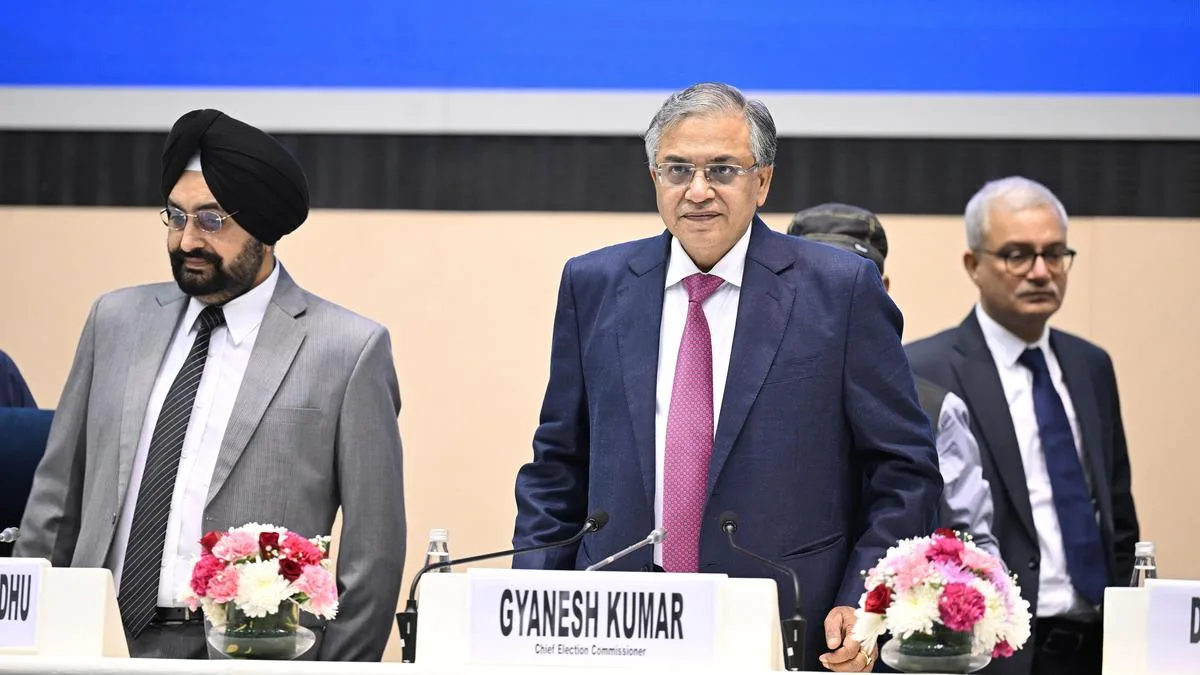
CEC Gyanesh Kumar's affidavit states that removal procedures mirror those for Supreme Court judges.
Petitioners, including opposition leaders, challenge the CEC's functioning based on media reports.
The ECI emphasizes collective decision-making, denying any unilateral actions by the CEC.
In a significant legal assertion, the Election Commission of India (ECI) has filed a joint affidavit in the Supreme Court, stating that the Chief Election Commissioner (CEC) can only be removed from office in a manner akin to the ousting of a Supreme Court judge. This affidavit, submitted on October 26, 2026, emphasizes that any attempts to limit the CEC's authority would contravene established legal frameworks.
The nearly 250-page document counters claims made by petitioners, including prominent opposition figures and leaders from the INDIA bloc, who have raised concerns about the CEC's alleged unilateral decision-making and internal conflicts. The ECI's affidavit contends that such media reports do not constitute valid evidence for legal proceedings, asserting that petitions based on these reports lack merit in court.
The affidavit highlights that the CEC, alongside Election Commissioners Sukhbir Singh Sandhu and Vivek Joshi, operates under a collective decision-making process. It outlines that decisions are made through a majority rule, as stipulated in the Chief Election Commissioner and Other Election Commissioners (Appointment, Conditions of Service and Term of Office) Act, 2023. The document asserts that no unilateral decisions are made, with all actions being documented and approved by the relevant officials before implementation.
Moreover, the ECI acknowledges that in urgent situations requiring immediate action, decisions may be made electronically, but these are subsequently recorded in official files. The affidavit also addresses a controversial internal order from July 28, 2026, which had raised concerns about the conduct of Senior Deputy Election Commissioner Maneesh Garg, indicating that it was issued without the consensus of the other Election Commissioners.
Looking ahead, the ECI's stance in this case will likely influence ongoing discussions about electoral governance and the authority of the CEC. The Supreme Court's response to the affidavit and the subsequent legal proceedings will be closely monitored, as they could set important precedents regarding the functioning and accountability of the Election Commission in India.