New Insights on Naegleria Fowleri's Invasion Tactics Revealed
Recent research uncovers how the brain-eating amoeba exploits confined spaces to invade the human brain.
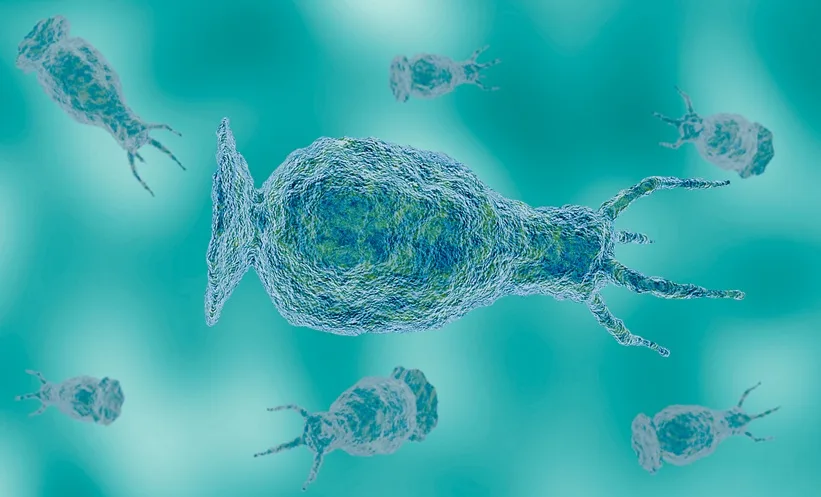
Naegleria fowleri has a 95% fatality rate, particularly affecting children after freshwater exposure.
The amoeba exhibits a unique behavior called claustrophilia, preferring tight spaces for rapid migration.
Investigations show that once inside narrow channels, the amoeba doubles its speed, enhancing its neurotropic invasion.
Recent studies have shed light on the mechanisms employed by Naegleria fowleri, a deadly amoeba responsible for primary amoebic meningoencephalitis (PAM), which has a staggering fatality rate of around 95%. This pathogen primarily affects children who come into contact with contaminated freshwater. While it is known that the amoeba enters the body through the nasal passages during water activities, the precise biological processes that facilitate its swift movement through the cribriform plate, a critical area in the nasal cavity, have remained largely unexplained until now.
Researchers have discovered that Naegleria fowleri exhibits a behavior termed claustrophilia, which describes its preference for navigating through narrow anatomical spaces. By studying the amoeba's movement in various microenvironments, scientists found that it switches to a specific mode of locomotion when encountering channels that mimic the tight spaces surrounding human olfactory axons. This adaptation allows the amoeba to effectively probe and enter these confined areas, achieving entry rates of 65% to 100% without the need for chemical signals or fluid assistance.
The study utilized three-dimensional hydrogel matrices to replicate pond sediments, revealing that the amoeba can burrow into dense environments while retaining its directional memory. This capability is crucial in natural freshwater habitats, where the amoeba forages for bacteria among tightly packed silt. However, in a human host, these survival traits transform into lethal mechanisms. Once inhaled, the amoeba uses its directional memory and claustrophilia to navigate the nasal cavity and penetrate the olfactory nerve sheaths, ultimately reaching the brain rapidly.
The implications of this research are significant for public health, particularly in areas where freshwater exposure is common. Understanding how Naegleria fowleri navigates confined spaces can lead to improved clinical protocols and preventive measures against this deadly infection. As the amoeba can reach cerebral tissue before medical intervention can occur, timely awareness and education about the risks associated with freshwater activities are essential.
Looking ahead, further research is needed to explore potential therapeutic strategies that could disrupt the amoeba's navigation and invasion processes. As scientists continue to unravel the complexities of Naegleria fowleri, the hope is to develop effective interventions that could save lives in the face of this formidable pathogen.