India's GDP Growth Projected to Exceed 7% for Fifth Year
India's economy is set to grow over 7% for the fifth consecutive year, highlighting significant urban expansion challenges.
India's GDP growth is projected at over 7% for five consecutive years.
The current economic scale is nearly four times larger than during the previous growth boom from 2003-2007.
Urban infrastructure and services must adapt to the rapid economic expansion.
India's economy is on track to achieve a growth rate exceeding 7% for the fifth consecutive year, as reported by Kyunghoon Kim from the Korea Institute for International Economic Policy. This sustained growth is notable not just for its percentage but also for the scale, with the economy now nearly four times larger than it was during the previous growth period from 2003 to 2007.
Historically, India's economy has shown resilience, rebounding by 9.7% in 2021 after a contraction of 5.8% in 2020 due to the Covid-19 pandemic. The average growth rate between 2021 and 2025 is projected at 7.83%, marking it as the second-highest five-year average since 1960. This growth comes despite external challenges such as the Russia-Ukraine war and fluctuating global trade policies.
The current economic expansion is driven by a combination of domestic demand, favorable demographic trends, and proactive policy reforms. However, while aggregate GDP growth indicates a booming economy, it does not guarantee improved living conditions or infrastructure adequacy in urban areas. The report emphasizes that urban economies are closely linked to domestic consumption, which is crucial for sustaining growth.
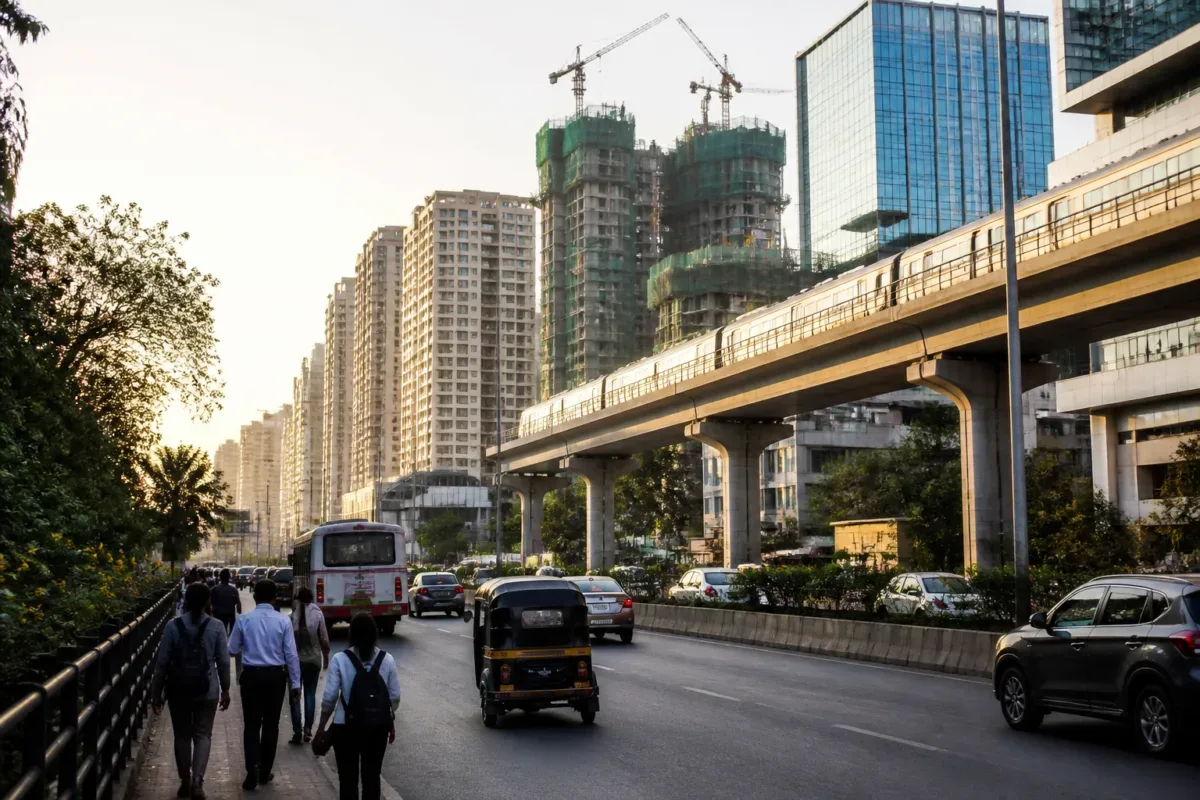
The implications of this growth are significant for urban planning and infrastructure development. As cities expand, the demand for housing, transportation, and public services increases. Yet, the report raises concerns about whether smaller cities and rural areas are benefiting from this growth or if it is concentrated in major metropolitan regions. The ability of urban institutions to manage this demand effectively will be critical to ensuring that economic growth translates into improved living standards.
Looking ahead, India’s economic trajectory suggests a potential to become the world’s third-largest economy by 2031. However, the real test lies in translating this growth into livable urban environments. Policymakers will need to focus on the composition of growth, investment distribution, and the capacity of urban infrastructure to meet the demands of a rapidly growing population.