Tamil Nadu Report Confirms Historical Survey Pillar on Thiruparankundram Hill
A recent report by Tamil Nadu's government identifies a survey pillar on Thiruparankundram hill, shedding light on its historical significance amidst ongoing disputes.
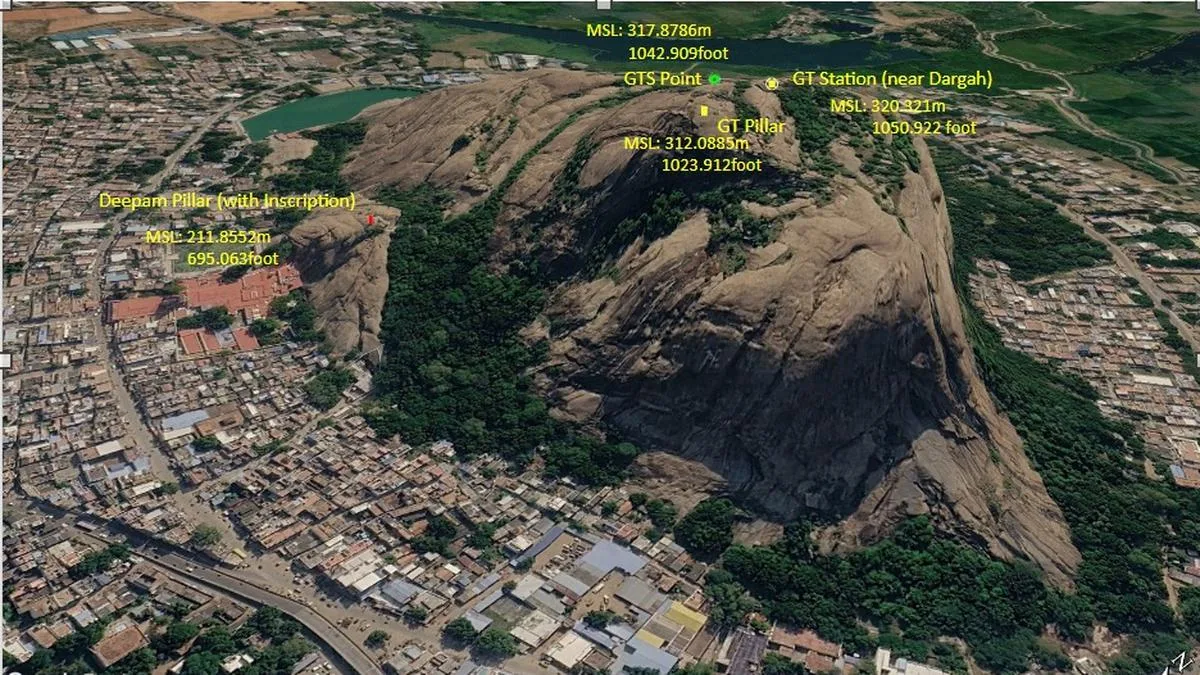
The pillar is confirmed as a Great Trigonometrical Survey pillar from the British era.
The report documents over 800 survey stations, with Thiruparankundram identified as a secondary station.
Recent legal decisions have reignited interest in the historical significance of the site.
A comprehensive report released by the Tamil Nadu government has confirmed that a pillar located near the Sikandar Badusha Dargah on Thiruparankundram hill is a Great Trigonometrical Survey (GTS) pillar, originally erected during British rule. This finding comes at a crucial time, as discussions around the lighting of the Karthigai Deepam at the site have intensified, following a Supreme Court ruling that allowed for a limited, one-time lighting arrangement at a newly identified deepathoon.
The report, compiled by the Departments of Survey and Settlement and Archaeology, details triangulation measurements from the Sikandarmalai hill station to various other locations, including Nagamalai and the Meenakshi Amman temple in Madurai. These measurements align with historical data from the GTS conducted during the colonial period, reinforcing the pillar's significance as a survey marker.
In its five-volume report, which spans over 1,800 pages, the government identified more than 800 survey stations, with Thiruparankundram classified as a secondary station. The report highlights that 484 of these stations were physically documented, including the stone pillar and associated markings at Thiruparankundram, which serve as critical reference points for cartography and land management.
The impetus for this extensive survey arose from a directive issued by the Revenue and Disaster Management Department in December 2025, aimed at systematically identifying and preserving GTS stations across Tamil Nadu. The findings are particularly relevant as urbanization and natural changes have rendered many historical survey points untraceable, emphasizing the need for documentation and preservation efforts.
Looking ahead, the Tamil Nadu government plans to continue its efforts to identify and map all GTS stations, utilizing their coordinates for future surveys. This initiative is expected to enhance understanding of the region's historical geography and improve land management practices in the state.