PM Surya Ghar Initiative Boosts Solar Capacity by 19 MW
The PM Surya Ghar scheme significantly enhances India's residential rooftop solar capacity, with Gujarat, Maharashtra, and UP leading the way.
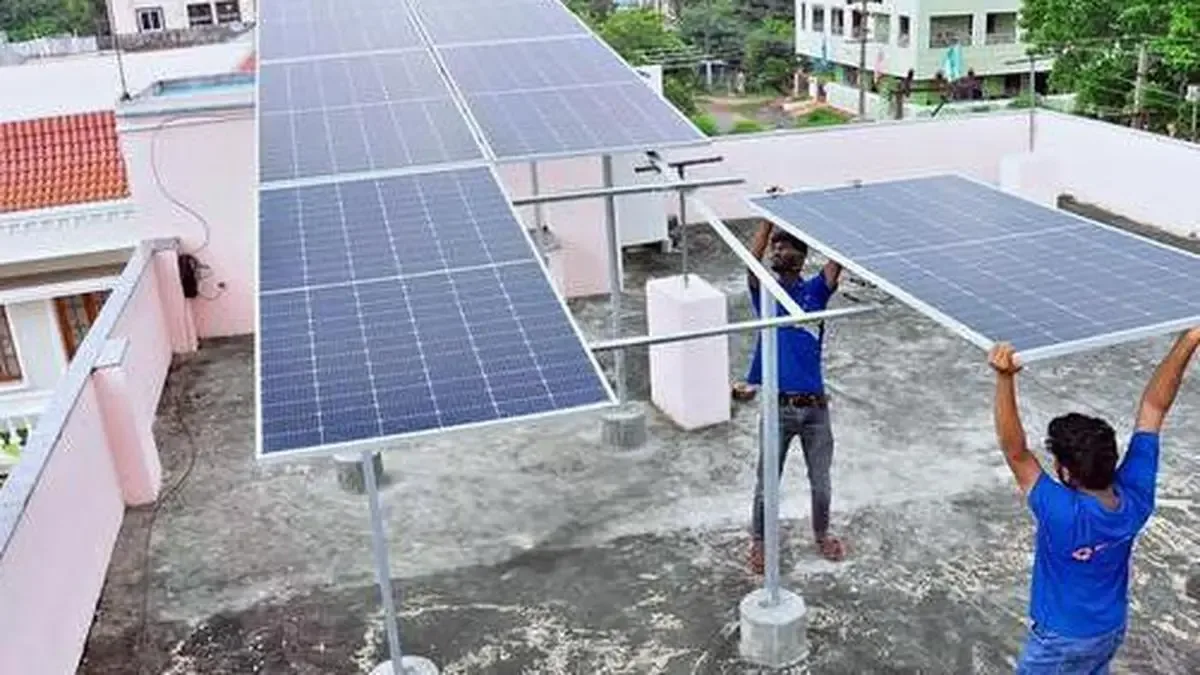
The PM Surya Ghar scheme has added over 19 MW of rooftop solar capacity.
Gujarat, Maharashtra, and Uttar Pradesh together account for more than 51% of India's total residential solar capacity.
Kerala leads in generation density with the highest average output per installation.
The PM Surya Ghar: Muft Bijli Yojana (PMSG: MBY), a flagship initiative by the Indian government, has successfully added over 19 MW of residential rooftop solar capacity across the country. According to the Ministry of New & Renewable Energy (MNRE), this scheme has facilitated the installation of nearly 57 lakh operational units nationwide, with Gujarat, Maharashtra, and Uttar Pradesh emerging as the top contributors to this growth.
Gujarat stands out as the leader in solar capacity, boasting an impressive 3,523.98 MW, supported by substantial central subsidies amounting to ₹6,819.9 crore. Following closely is Maharashtra, which has installed 3,336.54 MW across 9.15 lakh installations, backed by ₹6,437.53 crore in subsidies. Uttar Pradesh ranks third with 3,231.59 MW, receiving ₹6,510.47 crore in financial support. Collectively, these three states represent over 51.11% of India's total residential rooftop solar capacity, which currently stands at 19,744.31 MW.
While these states lead in overall capacity, Kerala has distinguished itself in terms of generation density, achieving 1,602.73 MW from 4.14 lakh installations. Kerala's average output per installation is 3.87 kW, the highest among major states, surpassing Gujarat's 3.75 kW, Maharashtra's 3.64 kW, and UP's 3.35 kW. This success is attributed to strong adoption rates in commercial setups and among high-consumption residential users.
The distribution of solar installations illustrates how different states are adapting solar energy solutions to their specific residential contexts. Maharashtra has emerged as a hub for multi-family solar adoption, with 9.16 lakh installations serving 13.97 lakh households, averaging 1.53 families per setup. Gujarat follows a similar pattern, with 9.38 lakh setups powering 13.21 lakh households. In contrast, Uttar Pradesh and Kerala show robust growth through individual installations, with UP operationalizing 9.66 lakh setups for 9.75 lakh households, and Kerala powering 4.21 lakh families with its 4.14 lakh installations.
Overall, the PM Surya Ghar initiative has disbursed approximately ₹37,533 crore in central subsidies, facilitating the operationalization of 19,744.31 MW of decentralized renewable energy generation. As Rajasthan continues to expand its decentralized solar footprint, contributing 1,456.86 MW across 3.72 lakh installations, the initiative is helping to alleviate peak load pressures on distribution networks and reduce transmission losses across the country.