Nagpur's Solar Defence Completes Trials for Bhargavastra Anti-Drone System
The indigenous counter-drone system Bhargavastra has successfully passed trials, marking a significant advancement in India's defense technology.
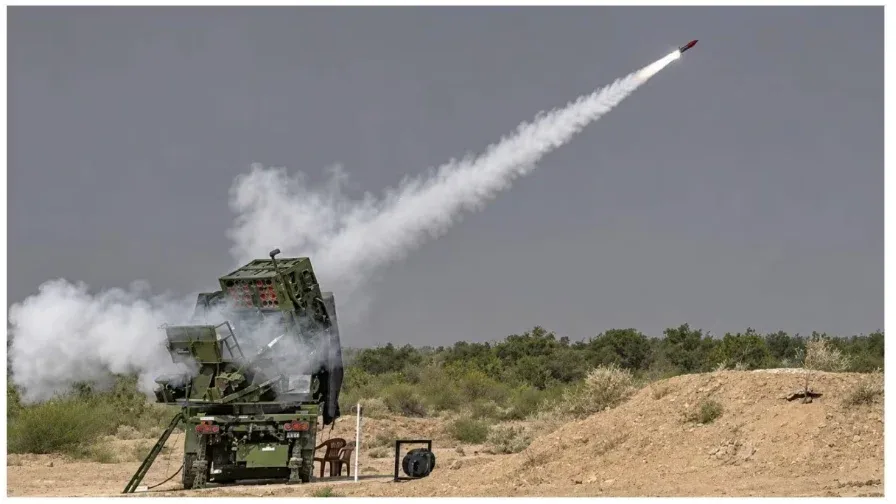
Bhargavastra is India's first vehicle-mounted counter-swarm drone system.
The system integrates air defense rockets and guided micro-missiles for effective drone engagement.
Successful trials pave the way for prototype demonstration and potential Army induction.
In a notable advancement for India's defense capabilities, Solar Defence and Aerospace Limited (SDAL) based in Nagpur has successfully conducted trials for its indigenous counter-drone system, Bhargavastra, at the Pokhran Field Firing Ranges in Rajasthan from November 20 to 24. This system is designed to counter the increasing threat from hostile drone swarms, marking a significant milestone in the development of home-grown defense technology.
Bhargavastra is distinguished as India's first two-layer, vehicle-mounted counter-swarm drone system. It combines air defense rockets with guided micro-missiles into a single platform, allowing for the simultaneous targeting of multiple drones. The entire system, including its software, has been developed and integrated within India, showcasing the country's growing capabilities in defense technology.
The project was initiated in response to specific requirements from the Indian Army, with the Ministry of Defence approving the development of Version-I on July 9, 2024. This version is based on rockets and falls under the Make-II category, with a completion target set for March 31, 2027. Following the successful demonstration of a prototype, the Army plans to procure 12 systems. However, SDAL has advanced the project by developing an enhanced Version-II that includes guided micro-missiles featuring autonomous guidance and infrared seekers.
During the recent trials, both rockets and guided micro-missiles were successfully fired against swarm-drone targets, demonstrating the system's operational effectiveness. The layered defense mechanism of Bhargavastra utilizes radio-frequency detectors and surveillance radars to identify and track incoming drones, while an AI-enabled C4I architecture coordinates detection and engagement processes. The system's Version-I configuration includes a 64-tube rocket launcher, while Version-II expands capabilities with a launcher for 64 guided micro-missiles.
The successful completion of these trials positions Bhargavastra for its upcoming prototype demonstration, which will be critical for the Army's evaluation and potential induction. This development is particularly relevant given the evolving nature of modern warfare, where inexpensive unmanned aerial vehicles can challenge traditional air defense systems. Bhargavastra aims to provide a robust, indigenous response to these emerging threats, further solidifying Nagpur's role in India's defense manufacturing landscape.