IIT Ropar Study Reveals Nanobubbles Enhance Drug Crystallization
A groundbreaking study from IIT Ropar demonstrates how nanobubbles can revolutionize pharmaceutical manufacturing by improving crystallization efficiency.
Nanobubbles significantly accelerate crystal formation and reduce size in drug manufacturing.
The method can increase production yields by up to 65%, even under challenging conditions.
Maintaining consistent nanobubble concentration remains a challenge for large-scale applications.
A recent study conducted by researchers at the Indian Institute of Technology (IIT) Ropar has unveiled a novel approach to enhance the crystallization process of essential medicines using nanobubbles. These microscopic bubbles, which are not visible to the naked eye, are integrated into the cooling and antisolvent crystallization processes of paracetamol, leading to faster crystal formation, reduced crystal size, and improved production yields. This advancement is particularly significant in pharmaceutical manufacturing, where the size and shape of drug crystals play a crucial role in their efficacy and absorption in the human body.
The research team explored the impact of nanobubbles on crystal behavior through a series of controlled experiments involving paracetamol dissolved in ethanol. They generated bulk nanobubbles, measuring between 150-200 nanometers, by bubbling pure gases such as oxygen, nitrogen, and carbon dioxide through the solution. This process involved passing the gases through a porous membrane at a consistent flow rate for a specified duration. The solution's temperature was carefully regulated while varying the stirring rate to observe how these factors influenced the crystallization outcomes.
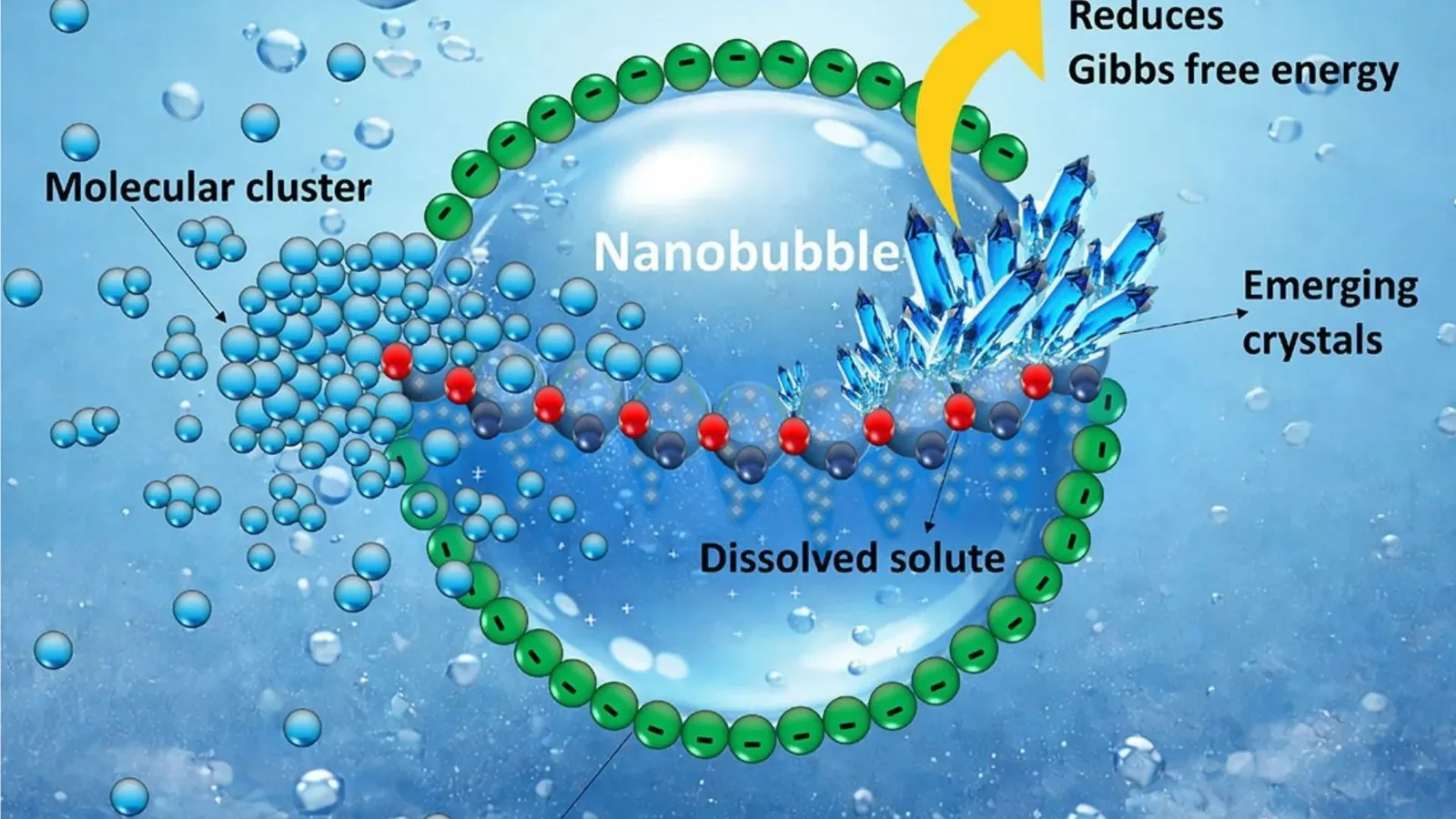
The findings revealed that the high surface-to-volume ratio and negative electrostatic charge of the nanobubbles create ideal conditions for crystal nucleation. When the solution becomes supersaturated, dissolved molecules rapidly adhere to the nanobubbles, forming localized areas of high supersaturation. This phenomenon effectively lowers the Gibbs free energy barrier, facilitating the formation of crystals. The study demonstrated that nanobubbles not only promote early nucleation but also prevent clumping, resulting in smaller and more uniform crystals.
Remarkably, the nanobubble technique proved effective even in adverse conditions, such as elevated temperatures and low antisolvent concentrations, where traditional methods failed to produce crystals. The researchers noted that oxygen nanobubbles were particularly effective in reducing crystal size due to their unique gas-solubility dynamics. This innovative approach could lead to faster-acting medications and more efficient pharmaceutical production processes, reducing the need for chemical additives.
Despite these promising results, the researchers acknowledged that challenges remain in maintaining a consistent concentration of nanobubbles and ensuring uniform crystal size in large-scale industrial applications. If these hurdles can be overcome, this sustainable technology could transform drug manufacturing, offering a low-energy, environmentally friendly solution that enhances crystal yield and produces high-quality pharmaceutical products worldwide.