IMF Adjusts 2026 Global Growth Forecast to 3.1%
The IMF has raised its global growth forecast for 2026 to 3.1%, citing resilience in advanced economies but warns of vulnerabilities in low-income nations.
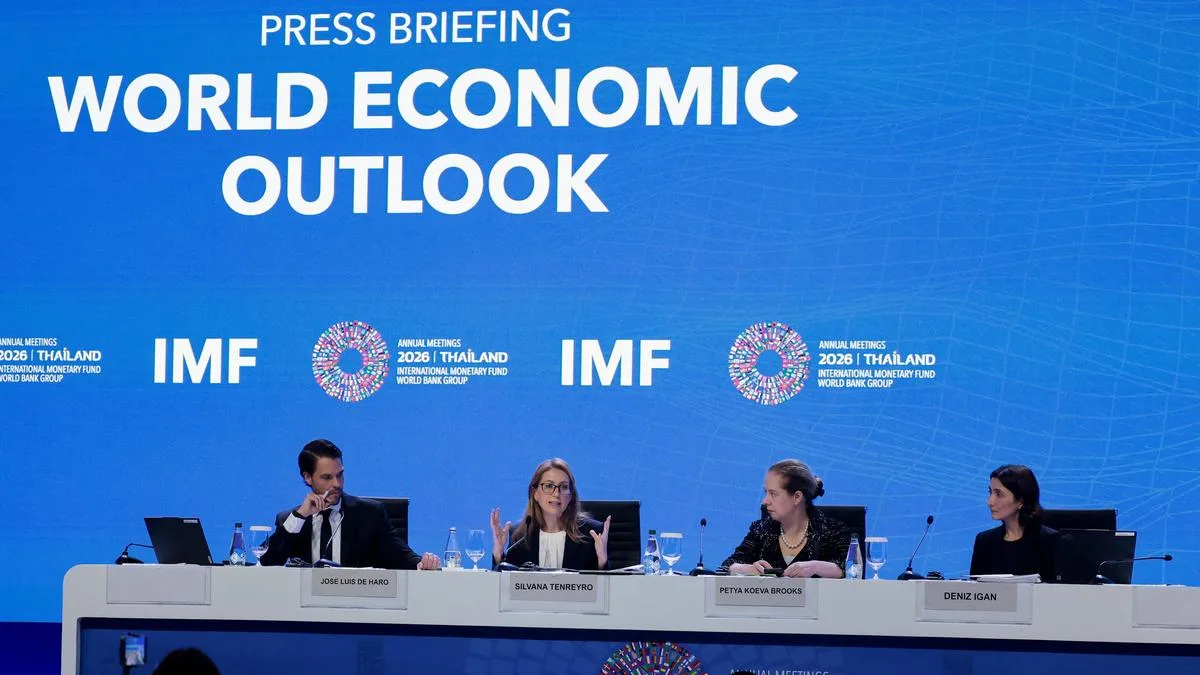
IMF forecasts a 3.1% global growth in 2026, up from previous estimates.
Low-income countries remain at risk due to high energy prices and geopolitical tensions.
The report highlights a 'bifurcated outlook' with stark contrasts between advanced and developing economies.
On October 13, 2026, the International Monetary Fund (IMF) announced an upward revision of its global growth forecast for 2026, projecting an increase to 3.1%. This adjustment reflects the resilience of advanced economies amidst ongoing geopolitical tensions and rising energy costs, particularly due to the conflict in Iran. However, the IMF cautioned that low-income countries continue to face significant vulnerabilities as they grapple with the repercussions of these supply shocks.
The IMF's World Economic Outlook, unveiled during its Annual Meetings in Bangkok, indicated that while advanced economies benefit from increased investments in artificial intelligence (AI), poorer nations are not reaping similar rewards. These countries are struggling with soaring energy prices exacerbated by the Iran war, which has disrupted global supply chains. Silvana Tenreyro, the IMF's chief economist, emphasized that although the global economy has shown resilience, it is under considerable strain, with risks skewed towards a downturn.
The report outlined that the ongoing conflict in the Middle East, particularly the war involving Iran, has led to a dramatic increase in global energy prices, with refined petroleum products priced significantly higher than pre-war levels. This situation has placed immense pressure on energy-importing nations, particularly those not benefiting from the AI boom. The IMF characterized this scenario as a 'bifurcated outlook,' highlighting the contrasting economic trajectories of different regions. Tenreyro noted that the economic fallout from the war could lead to heightened inflation and hinder growth, particularly for low-income and energy-dependent countries.
In terms of specific regional impacts, the Middle East and Central Asia are expected to experience a contraction of 0.3% in 2026, with Saudi Arabia projected to face a 3.3% shrinkage in its economy. Conversely, advanced economies are anticipated to grow by 2.1%, buoyed by technological advancements and investment in AI. The IMF also pointed out that while growth in China is expected to slow due to weak domestic demand, global inflation is set to rise to 4.7% in 2026, affecting both developed and developing nations.
Looking ahead, Tenreyro urged governments worldwide to take immediate action to mitigate the risks posed by high energy prices and inflation. She advocated for targeted, temporary measures to alleviate public burdens while maintaining a focus on price stability through appropriate monetary policies. The IMF's report underscores the urgent need for a shift from merely coping with economic challenges to rebuilding and enhancing resilience in fiscal and supply chains.