Pakistan's Muhammad Zeeshan Ali Joins China's Shenzhou-24 Mission
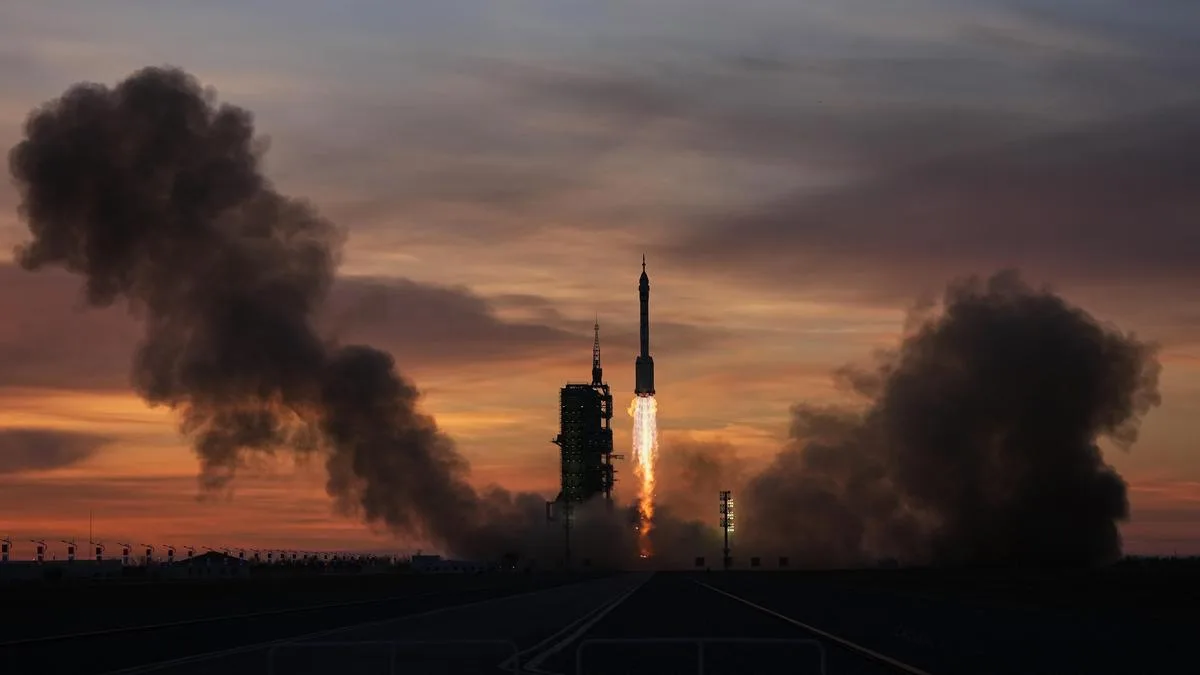
On November 25, 2026, China successfully launched the Shenzhou-24 spacecraft, marking a historic moment as it carries Pakistan's first astronaut, Muhammad Zeeshan Ali.
Muhammad Zeeshan Ali becomes the first foreign astronaut in China's crewed space program.
The Shenzhou-24 mission aims to conduct over 90 scientific experiments during its duration.
Pakistan's leadership celebrates the mission as a significant milestone for the nation's space ambitions.
On November 25, 2026, China successfully launched its Shenzhou-24 crewed spaceship from the Jiuquan Satellite Launch Centre, carrying three astronauts, including Muhammad Zeeshan Ali from Pakistan. This mission marks a significant milestone as Ali becomes the first foreign national to participate in China's crewed space program. The launch was declared successful shortly after the spacecraft lifted off atop a Long March-2F carrier rocket.
The crew of Shenzhou-24 includes mission commander Tang Hongbo, flight engineer Wu Yi, and Ali, who is set to spend approximately one week in orbit before returning to Earth aboard the Shenzhou-23 spacecraft. In contrast, Chinese astronauts typically remain at the Tiangong space station for about six months. The spacecraft is expected to dock with the Tiangong station within hours of launch.
China established its own space station after being excluded from the International Space Station (ISS) due to concerns regarding military involvement in its space endeavors. The Tiangong space station, operational since 2022, is currently the only one of its kind in operation, although it is smaller than the ISS, which has hosted astronauts from various countries for over 3,000 experiments since its inception in 1998.
The Shenzhou-24 mission is designed to facilitate an in-orbit crew rotation, maintain station operations, and conduct scientific research, with over 90 experiments planned. These experiments will encompass a range of fields, including space life sciences, materials science, and space medicine. The collaboration between China and Pakistan on this mission stems from an agreement signed in February 2025, further strengthening their bilateral ties.
In Pakistan, Prime Minister Shehbaz Sharif expressed pride in the mission, stating it symbolizes the aspirations of 240 million Pakistanis. He thanked China for including a Pakistani astronaut in the mission. Planning Minister Ahsan Iqbal emphasized that this launch represents a new era for Pakistan's space program, highlighting the potential for technological advancement and the deepening friendship between Pakistan and China. The mission is seen as a significant step toward Pakistan's future in space exploration.