Navi Pillay Awarded 2026 Nobel Peace Prize for Human Rights Advocacy
Former UN human rights commissioner Navi Pillay receives the 2026 Nobel Peace Prize, recognized for her commitment to peace and international law.
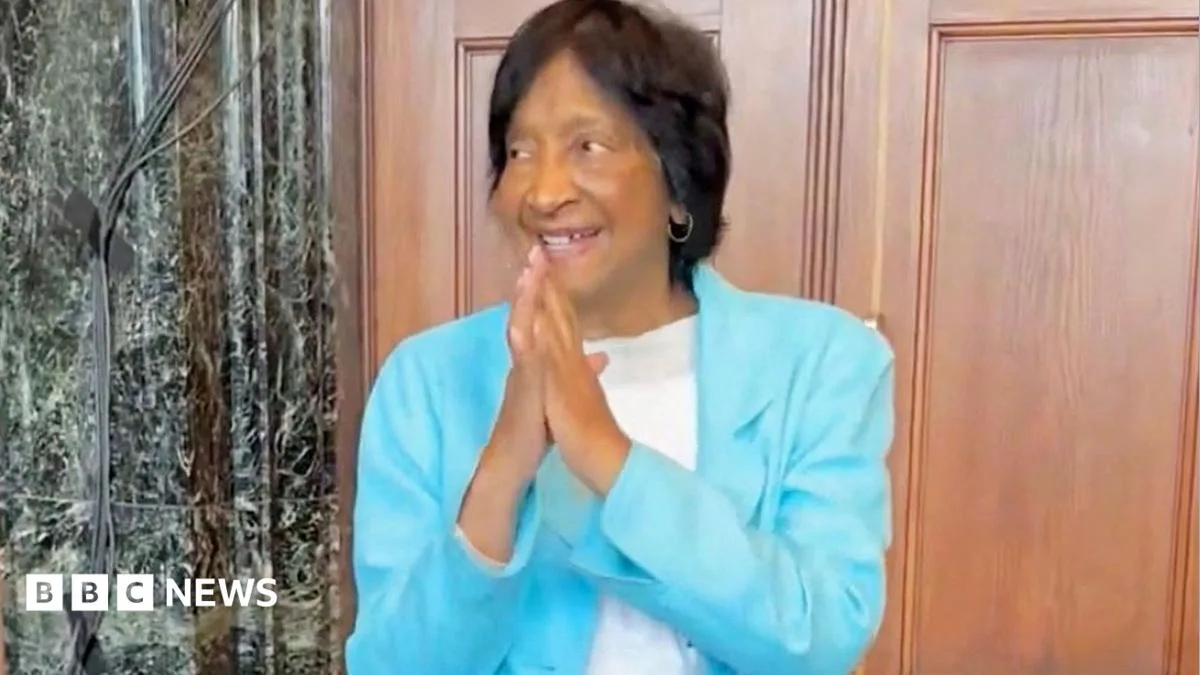
Navi Pillay is the fifth South African to win the Nobel Peace Prize.
Her award has sparked controversy, particularly from the Israeli government.
Pillay's career includes significant roles in international law and human rights advocacy.
Navi Pillay, a distinguished former UN human rights commissioner, has been awarded the 2026 Nobel Peace Prize for her unwavering dedication to promoting peace and international law. The announcement was made by the Norwegian Nobel Committee in Oslo, highlighting Pillay's impactful career and her contributions to human rights. Upon receiving the news, Pillay expressed disbelief and humorously suggested a shared celebration with former US President Donald Trump, referencing last year's winner's controversial gesture of giving her medal to Trump.
Born in Durban, South Africa, Pillay has a rich history in human rights advocacy. She served as the president of the International Criminal Tribunal for Rwanda during the late 1990s and early 2000s. More recently, she chaired the UN Independent International Commission of Inquiry on the Occupied Palestinian Territory, which was established to investigate alleged violations of international law. This commission's findings, which concluded that Israel had committed genocidal acts in Gaza, have drawn significant criticism and backlash from the Israeli government.
The Israeli Foreign Ministry condemned Pillay's recognition, labeling it a distortion of the Nobel Prize's intent and accusing her of promoting anti-Israel sentiments. In a statement, they described her role in the UN commission as politically motivated and claimed it legitimizes hatred against Israel. This reaction underscores the contentious nature of her work and the polarized views surrounding the Israeli-Palestinian conflict.
South African President Cyril Ramaphosa praised Pillay's award as a testament to her principled service to humanity. He noted her pioneering efforts as a defense attorney for anti-apartheid activists and emphasized the importance of her contributions to peace and human dignity. Pillay's recognition marks her as the fifth South African Nobel Peace Prize laureate, following notable figures such as Nelson Mandela and Desmond Tutu.
Looking ahead, the Nobel Committee's decision has sparked discussions about the future of international law and human rights advocacy. As the global landscape continues to evolve, Pillay's recognition may inspire further dialogue on accountability and justice. The implications of her award will likely resonate within international legal circles and among human rights advocates as they navigate the complexities of current global issues.