India's CDS Highlights Pakistan's Growing Space Capabilities
General N S Raja Subramani emphasizes the need for India to enhance its space capabilities in response to Pakistan's advancements with Chinese assistance.
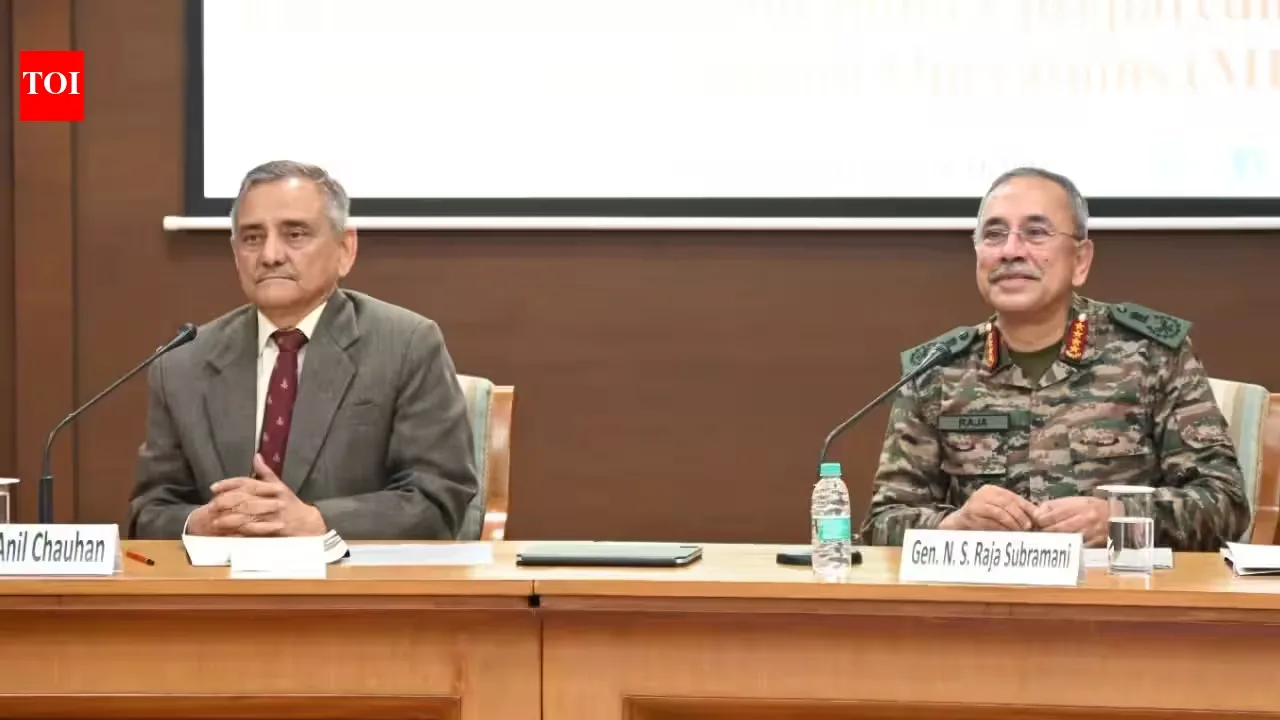
Pakistan's space capabilities are improving with China's support, according to India's Chief of Defence Staff.
India's Space-Based Surveillance Phase-III program aims to deploy 52 satellites for enhanced reconnaissance.
The military is modernizing its approach to warfare, focusing on integrated operations and technological advancements.
In a recent address, Chief of Defence Staff General N S Raja Subramani expressed concerns regarding the enhancement of Pakistan's space capabilities, which he attributed to assistance from China. He noted that the Pakistan Space and Upper Atmosphere Research Commission (SUPARCO) is actively working to develop its own space technology. General Subramani emphasized that India must take these developments into account to bolster its own capabilities, particularly in the context of multi-domain operations.
The General's remarks came during a discussion on the future of warfare, where he highlighted the importance of India's Space-Based Surveillance Phase-III (SBS-3) program. This initiative, approved by the Cabinet Committee on Security in October 2024, is set to deploy 52 reconnaissance and surveillance satellites at an estimated cost of ₹26,968 crore. The SBS-3 program aims to enhance India's awareness across land, air, and maritime domains, particularly in relation to its borders and the Indian Ocean Region.
General Subramani also addressed the need for India to modernize its military capabilities without engaging in an arms race with China. He stated that India should focus on maintaining sufficient capabilities to secure its borders rather than attempting to match China's military inventory directly. He mentioned ongoing projects like NavIC, SBS-3, and GSAT-7 as part of India's strategy to enhance its technological edge.
In terms of counter-drone technology, the CDS confirmed that directed energy weapons (DEWs) are being developed for operational use. He noted that laser weapons, which have been effectively deployed by Israel, are also being considered for integration into India's defense strategy. Furthermore, he outlined the military's commitment to reforming its acquisition processes to better align technological advancements with equipment procurement, emphasizing the need for a more agile approach in a rapidly changing technological landscape.
Looking ahead, General Subramani stressed the importance of a comprehensive national effort in modern warfare, where information and integrated command systems play crucial roles. He pointed to Operation Sindoor as an example of successful joint operations, underscoring the need for a tailored approach to military preparedness. The CDS concluded by reiterating that technological superiority is transient and requires continuous improvement to ensure readiness for future conflicts.