30 Confirmed Dead in Spain's High-Speed Train Collision
A tragic train collision in Toledo, Spain, has resulted in at least 30 fatalities, with rescue operations ongoing.

Two high-speed trains collided near Urda, Toledo, on Wednesday morning.
The crash involved a Renfe train carrying 397 passengers and an Iryo train with 147.
Initial reports suggest a possible signaling failure and human error may have contributed to the accident.
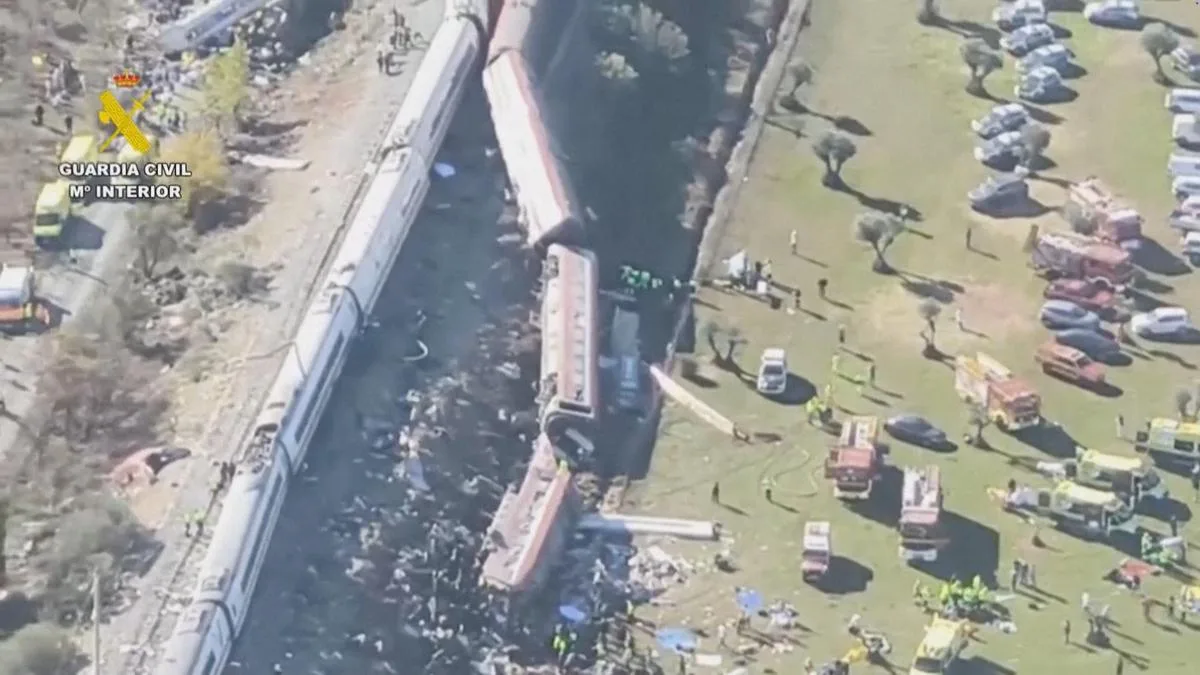
A devastating train collision in Toledo province, Spain, has resulted in the deaths of at least 30 individuals, with authorities indicating that the toll may rise. The incident occurred on Wednesday morning around 9 AM local time on the Madrid-Seville line, near Urda, when a Renfe high-speed train collided with the rear of a stationary Iryo train. The impact caused two carriages to derail, with reports indicating that some fell down an embankment. Emergency services quickly arrived at the scene to assist passengers trapped inside the wreckage.
The collision involved a Renfe AVE service and an Iryo train, both traveling towards southern Spain. The Renfe train was carrying 397 passengers, while the Iryo train had 147 passengers, including a baby, bringing the total number of individuals on board to 544. Following the crash, Spain’s rail infrastructure operator Adif announced the suspension of traffic on the high-speed line, as investigations into the cause of the accident began.
Preliminary reports from Spanish media suggest that the collision may have been caused by human error linked to a failure in the main signaling system. Sources indicated that the system had switched to manual operation after the failure, leading to several trains being halted in the vicinity. Allegations have surfaced that an operator at Madrid’s Atocha control center instructed the Renfe train to proceed despite the Iryo train being on the track, although these claims are still under investigation.
Rescue operations are currently underway, with emergency services deploying medical helicopters and mobilizing hospitals in Toledo and Alcázar de San Juan to treat the injured. Health Minister Mónica García reported that the impact was severe, and the situation could worsen as rescue efforts continue. Passengers trapped in the most damaged carriages are the focus of rescue teams, who are working to extract them from the wreckage.
This incident marks another tragic railway disaster in Spain this year, following a January collision near Adamuz that resulted in 46 fatalities. The recent crash has reignited concerns regarding railway maintenance and the safety of Spain's high-speed rail network. Investigators are now tasked with determining the exact causes of the collision, including the role of the reported signaling failure and potential human error.