Mohan Bhagwat Warns of Foreign Influence on Indian Stability
At the RSS's 101st Foundation Day, Mohan Bhagwat cautioned against foreign attempts to destabilize India's government, referencing unrest in other nations.
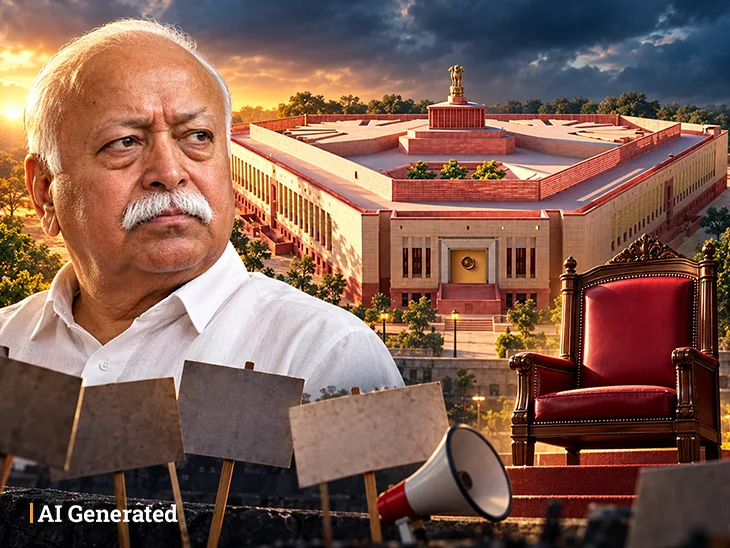
Mohan Bhagwat highlighted concerns over foreign interference in India's political landscape.
He cited examples from Bangladesh, Nepal, and France to illustrate potential threats to India's stability.
Bhagwat asserted that internal divisions could be exploited to undermine trust in institutions.
During the RSS's 101st Foundation Day celebrations on October 20, Mohan Bhagwat, the chief of the organization, issued a stark warning regarding foreign interference aimed at destabilizing the Indian government. Speaking in Nagpur, he expressed concerns about 'regime change' and emphasized that powerful nations may perceive India's growing influence as a challenge to their dominance. Bhagwat's remarks were framed within a broader context of global political unrest, drawing parallels with recent events in countries like Bangladesh, Nepal, and France.
Bhagwat elaborated on the destructive influences emanating from the West, which he claimed threaten cultural and human values in India. He alleged that certain global powers are attempting to weaken India by creating instability and placing individuals aligned with their interests in key positions. He cautioned that internal disagreements within India could be manipulated to foster distrust in governmental institutions, exacerbate social divisions, and incite public discontent. Despite these assertions, Bhagwat did not provide concrete evidence of a coordinated foreign-backed effort to change India's government.
To substantiate his warnings, Bhagwat referenced the political turmoil in various countries. In France, widespread protests arose over issues such as education and living costs, while in Albania, demonstrators demanded the resignation of Prime Minister Edi Rama amid clashes with police. Bangladesh experienced a significant uprising that led to the resignation of Prime Minister Sheikh Hasina after over 15 years in power. In Nepal, protests against a social media ban escalated into broader discontent, resulting in the resignation of Prime Minister KP Sharma Oli. By citing these instances, Bhagwat implied that India must remain vigilant against similar destabilizing efforts.
The RSS's concerns about foreign interference have been shaped by various events over the past decade, including the 'Urban Naxal' debate, which highlighted alleged Maoist influences in universities and civil society. Additionally, international attention on India's farmers' protests, including support from global figures, raised suspicions of foreign involvement. However, the mere presence of international support does not inherently indicate foreign orchestration of protests.
Looking ahead, the implications of Bhagwat's warnings could resonate throughout India's political landscape. As public protests have historically influenced political outcomes, the potential for protests to reshape public opinion remains significant. Senior journalist Neerja Chowdhury noted that excessive governmental force against protesters could alienate citizens and shift public sentiment against the ruling party. While Bhagwat asserted that regime change is unlikely in India, the evolving political climate necessitates ongoing vigilance against both internal and external challenges.