Bibha Chowdhuri's 1939 Breakthrough in Cosmic Ray Photography
In 1939, physicist Bibha Chowdhuri pioneered a method to visualize cosmic rays using photographic plates, marking a significant advancement in particle physics.
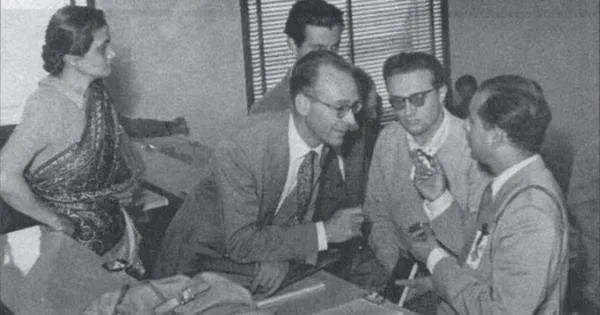
Bibha Chowdhuri published groundbreaking research on cosmic rays in 1939.
Her experiments revealed 30 tracks of nuclear disintegration using photographic plates.
Chowdhuri's work contributed to the development of particle detection methods in physics.
In 1939, Bibha Chowdhuri, a 26-year-old physicist, made a significant contribution to the field of particle physics by publishing an article detailing her innovative experiments with photographic plates. Conducted in locations such as Calcutta and Sandakphu, her work aimed to uncover traces of cosmic rays, which were otherwise invisible to the naked eye. By placing photographic plates treated with samarium sulphate in various environments, Chowdhuri was able to capture evidence of nuclear disintegration, leading to the discovery of 30 distinct tracks that resembled stars.
Chowdhuri's experiments were part of a broader scientific movement during the late 1930s, which sought to utilize photographic emulsions as detectors for subatomic events. Her collaboration with renowned physicist DM Bose at the Bose Institute in Calcutta was pivotal. Together, they developed methods to differentiate between various particles based on the tracks they left on photographic plates. This work not only advanced Chowdhuri's career but also laid the groundwork for future research, including the Nobel Prize-winning studies by Cecil Powell.
The methodology employed by Chowdhuri was groundbreaking for its time. By extending the exposure time of photographic plates, she was able to capture rare occurrences of nuclear disintegration, which traditional methods could not achieve. Her research demonstrated the effectiveness of photographic emulsions in detecting cosmic-ray-induced events, marking a shift in how particle physics experiments were conducted. Chowdhuri’s findings were corroborated by earlier studies, enhancing the credibility of her work.
The implications of Chowdhuri's research extended beyond her immediate findings. Her ability to visualize the interactions between cosmic rays and matter opened new avenues for understanding fundamental particles. This not only contributed to the field of particle physics in India but also positioned Indian scientists as key players in the global scientific community. The techniques she developed for detecting and analyzing subatomic particles have influenced subsequent research methodologies.
Looking ahead, Chowdhuri's legacy continues to inspire new generations of physicists. Her pioneering work in cosmic ray photography remains a significant chapter in the history of science, emphasizing the importance of innovative approaches in research. As the field of particle physics evolves, the foundational techniques established by Chowdhuri and her contemporaries will likely play a crucial role in future discoveries.