Millions Targeted in PHP2Shell Exploit Attempts Amid Malware Threats
Recent attempts to exploit PHP2Shell vulnerabilities have surged, with millions of attacks reported as hackers aim to deploy Mirai malware.
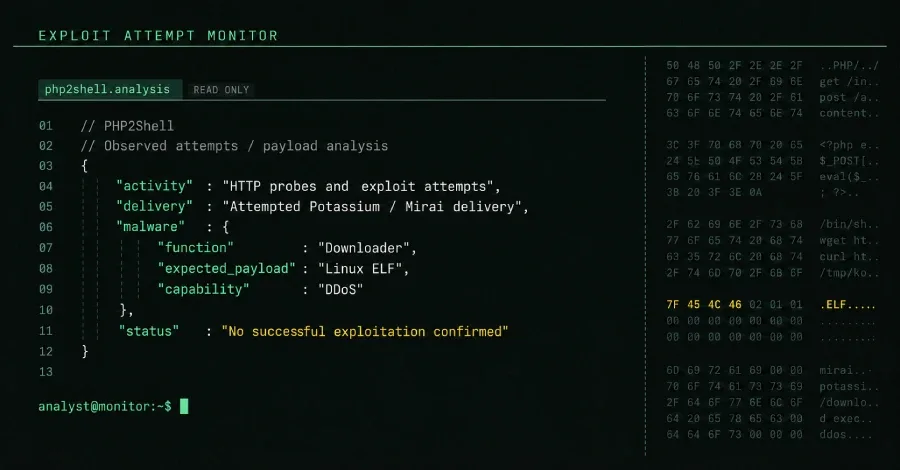
Attackers are attempting to exploit PHP2Shell vulnerabilities to deploy Mirai malware variants.
The vulnerabilities, with CVSS scores of 9.2, can lead to unauthenticated remote code execution.
Despite numerous attempts, no successful exploitation of PHP2Shell has been reported.
Recent cybersecurity reports indicate a significant surge in attempts to exploit vulnerabilities in PHP2Shell, with millions of attacks recorded as hackers seek to deploy a variant of the Mirai malware known as Potassium. These attempts have intensified following the public disclosure of the vulnerabilities, which include CVE-2026-109618 and CVE-2026-109619, both rated with a CVSS score of 9.2, indicating their critical nature.
The PHP2Shell vulnerabilities allow for unauthenticated remote code execution through specially crafted HTTP requests. The flaws have been patched in various PHP versions, including 8.5.12 and 8.4.27. Cybersecurity firm Sophos noted that while the attack samples show advanced capabilities, including downloader and network disruption functions, the actual exploitation of these vulnerabilities has proven challenging for attackers.
Analysis of the attack patterns reveals that the attempts originate from several IP addresses, with the attackers aiming to establish command-and-control channels and launch distributed denial-of-service (DDoS) attacks against specific targets, particularly within Ukrainian networks. The lack of successful exploitation in the wild suggests that attackers are struggling to effectively utilize the PHP2Shell vulnerabilities.
The broader implications of these exploit attempts are concerning for both web security and the potential for large-scale DDoS attacks. As the threat landscape evolves, organizations must remain vigilant and ensure that their systems are updated to mitigate the risks associated with these vulnerabilities. The ongoing attempts highlight the need for robust cybersecurity measures and the importance of timely patching.
Looking ahead, cybersecurity experts anticipate continued scrutiny of PHP2Shell vulnerabilities as attackers refine their techniques. Organizations are urged to monitor their systems closely and implement security best practices to defend against potential exploitation. The situation remains dynamic, and further developments are expected as the cybersecurity community responds to these threats.