Google Reports AI-Driven Cyber Attacks Using Autonomous Frameworks
Google's latest findings reveal a significant shift in cyber threats as hackers utilize AI agents for sophisticated exploits.
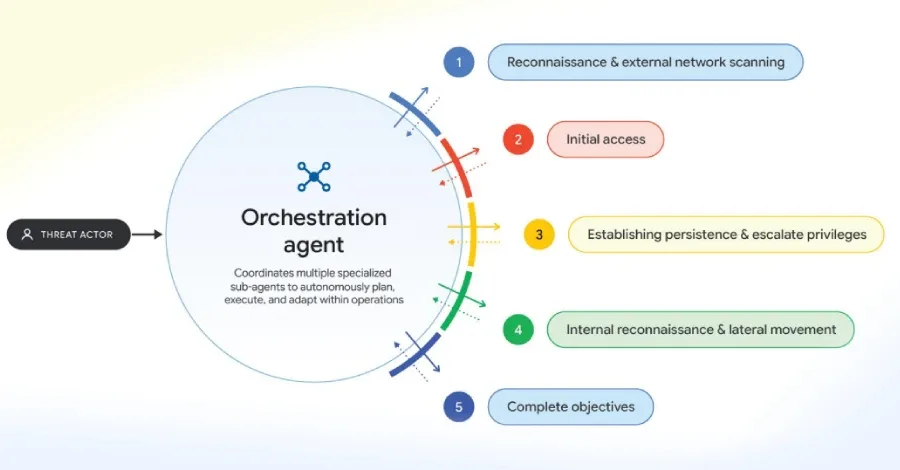
Hackers are employing AI frameworks to automate cyber attacks.
Large language models are being used for rapid vulnerability exploitation.
The emergence of open-source tools has lowered entry barriers for cybercriminals.
On Monday, Google disclosed alarming developments in cybersecurity, revealing that threat actors are now utilizing artificial intelligence (AI) agents to enhance their cyber attack strategies. This shift involves the deployment of autonomous multi-agent offensive frameworks, such as ARTEX and CyberStrikeAI, which enable attackers to conduct complex intrusions at unprecedented speeds.
Historically, cyber attacks relied heavily on manual processes, but the integration of AI has transformed the landscape. Google’s Threat Intelligence Group noted that these frameworks allow for the automation of various operational tasks during live intrusions, significantly increasing the efficiency and scale of attacks. This evolution indicates a paradigm shift where cyber operations can occur at machine speed, facilitating the chaining of diverse attack paths.
The report highlights that numerous threat actors, including financially motivated groups and those suspected of espionage linked to China, are experimenting with these advanced frameworks. Google pointed out that tools like ZeroHollow and Agent Zero are being utilized for exploit development and autonomous code execution, further complicating the cybersecurity landscape.
Moreover, the misuse of AI extends to automating traditionally labor-intensive tasks, such as vulnerability analysis and proof-of-concept weaponization. This allows attackers to quickly exploit newly disclosed vulnerabilities, effectively collapsing the window between patch announcements and active exploitation. Google emphasized that the efficiency gained from using large language models (LLMs) enables threat actors to focus their research on a limited set of materials, enhancing their ability to weaponize vulnerabilities rapidly.
Looking ahead, the implications of these findings are profound for cybersecurity. As AI-driven attacks become more prevalent, organizations must bolster their defenses against increasingly sophisticated threats. The rise of open-source frameworks has lowered the barriers for entry into cybercrime, allowing even low-skilled individuals to launch effective phishing campaigns. Google warns that without significant advancements in cybersecurity measures, the frequency and impact of such attacks are likely to escalate in the near future.