Asian Markets Plunge as AI Investment Doubts Rise
Asian stock markets face significant declines amid fears regarding the sustainability of the AI investment boom.
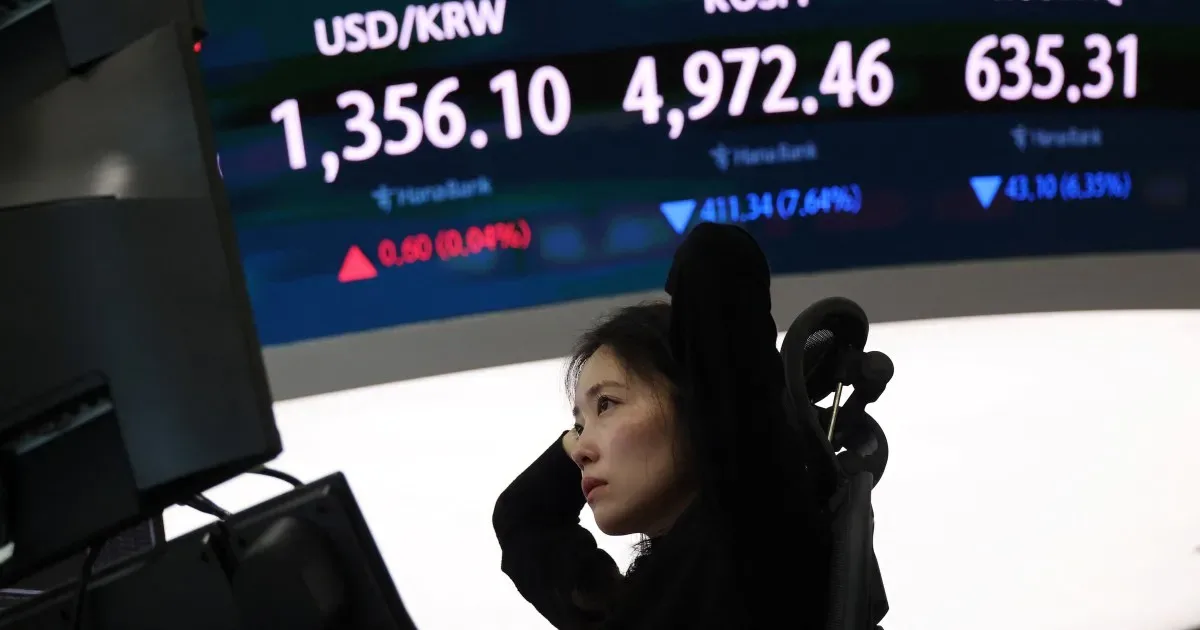
South Korea's Kospi index dropped by 5.8%, while Hong Kong's Hang Seng fell by 1.8%.
Global AI-related investments are projected to reach $2.7 trillion in 2026, raising concerns about sustainability.
US equity futures show signs of recovery, with strong semiconductor exports reported from South Korea.
Asian stock markets opened sharply lower on Monday, reflecting growing concerns about the viability of the ongoing AI investment boom. Major indices in South Korea, Taiwan, Hong Kong, and mainland China continued to decline, following a tech-driven sell-off that began last Friday. The Korea Composite Stock Price Index (Kospi) in Seoul experienced a notable drop of 5.8%, while Hong Kong's Hang Seng Index fell by 1.8%. In Shanghai, the CSI 300 Index decreased by over 1.3%, and the Taiwan Stock Exchange saw fluctuations after an initial drop of more than 1%.
This downturn follows a significant decline in US markets, where the S&P 500 closed 3.7% lower, marking a correction phase after a drop of over 10% from its recent peak. The Nasdaq Composite, heavily weighted with AI-focused companies, fell by 5.3%, erasing all gains made in 2026. The Kospi, Nikkei 225, and Taiex indices were all down between 5.1% and 6.2% by the end of the weekend, while the Hang Seng Index concluded the week down by 1.9%. Japan's markets were closed for Labour Thanksgiving Day, contributing to the overall regional decline.
Investors are now grappling with the implications of last week's sell-off, with many questioning whether the market correction has been excessive. Rajat Agarwal, an equity strategist at Societe Generale, noted that the markets are attempting to stabilize after a significant downturn in US tech stocks. The rapid rise in AI-related investments, projected to reach $2.7 trillion in 2026 and $3.6 trillion in 2027, has raised alarms about whether tech companies can sustain such high levels of investment, particularly as scrutiny over the sector increases.
The recent success of the Democratic Party in the US midterm elections is anticipated to slow down data center construction, which could further impact the tech sector. Additionally, Nvidia's ongoing espionage scandal has prompted calls for stricter regulations on China's access to advanced semiconductor technology. Khoon Goh, head of Asia research at ANZ, emphasized that concerns surrounding AI will dominate discussions this week as investors seek to gauge the market's bottom.
Despite the negative trends, there are some positive indicators, such as the rise in US equity futures and South Korea's strong export performance in early November, particularly in semiconductors, which saw a year-on-year increase of 294.4%. Investors will be closely monitoring these developments as they navigate the uncertain landscape of AI investments and market corrections.